Mensa Foundation Prize Awarded to NIH Neuroscientist
May 22, 2023
Dr. R. Douglas Fields is a pioneer on nervous system development, plasticity, memory
HURST, Texas - May 22, 2023 - PRLog -- R. Douglas Fields, Ph.D., a neuroscientist and author of numerous books and magazine articles about the brain, has been awarded the fourth Mensa Foundation Prize for his research in plasticity and active myelination in brains related to learning and intelligence.
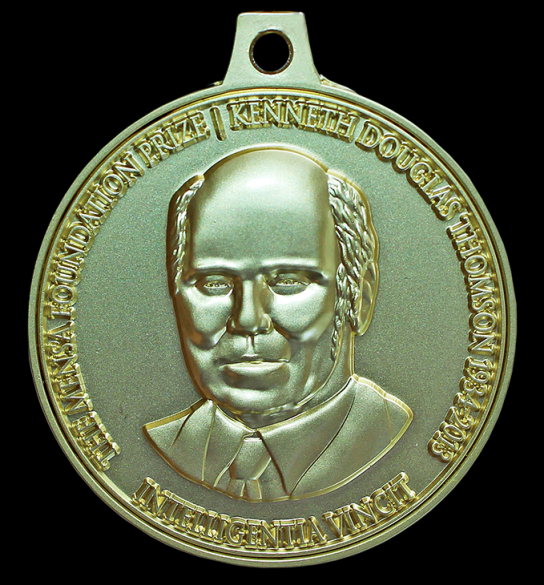
The biennial Mensa Foundation Prize honors the best discoveries in intelligence and creativity and is endowed by the estate of Kenneth Douglas Thomson (1934-2013), a longtime Mensa member. The award, which includes a $10,000 award, will be presented at American Mensa's Annual Gathering, July 5-9, in Baltimore, and Dr. Fields will give a presentation on his work.
Dr. Fields' long-standing research interest is in how functional activity influences nervous system development and plasticity along with the cellular mechanisms of memory. He is recognized internationally for his research on glia, which are brain cells that communicate without electricity, and for his pioneering discoveries on a new cellular mechanism of learning involving glial cells that form myelin. Myelin is the electrical insulation on nerve fibers, which speeds transmission of neural impulses. Dr. Fields' research shows that the glial cells forming myelin can sense neural impulse activity and that they contribute to learning and memory by changing the speed of neural impulse transmission to optimize the synchrony of information arriving at relay points in neural networks.
"I am especially gratified by my research on how myelin contributes to learning," Dr. Fields said, "because it overturns long-standing dogma about myelin — that it is static electrical insulation — and because it is a complete departure from how neuroscientists have thought about the mechanisms of learning and memory being based only on modifying synapses."
The Mensa Foundation Prize Committee praised the impressive scientific detail of Dr. Fields' work and his creative point of view. "Each small component of the rather complex glial model is backed by numerous rigorous multidisciplinary experiments involving imaging, chemistry, actual measurement of nerve conduction speed, and correlated animal learning experiments," said Dr. Susan Stine, Mensa Foundation Prize Committee member. "I think the sheer body of work and the observations using multiple experimental designs is amazing."
Joining Dr. Stine on the Mensa Foundation Prize Committee are:
- Dr. Harry Ringermacher, Ph.D., physics, the committee chair and a Mensa member.
- Dr. Ivar Giaever, Ph.D., physics, microbiologist, and winner of the 1973 Nobel Prize in Physics.
- Dr. Steven Maranz, Ph.D., plant science, microbiologist, and a Mensa member.
- Judith A. Keating, CPA, TCE-IRS, and a Mensa member.
Dr. Fields is Chief of the Nervous System Development and Plasticity Section at the National Institutes of Health, an American Association for the Advancement of Science Fellow, and University of Maryland adjunct professor. He received advanced degrees at U.C. Berkeley, San Jose State University, and U.C. San Diego and was a postdoctoral fellow at Stanford and Yale universities and at the NIH prior to starting his own NIH lab in 1994.
Outside the lab, he writes about science for Scientific American, Quanta, Outside Magazine, Huffington Post, Undark Magazine, Psychology Today, and many others. His neuroscience research has been featured on national television, radio, NPR, the National Geographic, and other media, and he speaks about neuroscience for the general public on NPR, World Science Festival, TEDex, Google Talks, and others.
The first Mensa Foundation Prize was awarded in 2017 to Dr. David Silver, who led Google's efforts to develop the first computer program to defeat the world's best Go players. In 2019 neuroscientist Dr. Aron K. Barbey was recognized for significantly advancing the neuroscience of brain connectivity with his innovative research applying functional magnetic resonance imaging to the mapping of brain lesions and measuring their effects on raw intelligence. And in 2021, statistical geneticist Dr. Danielle Posthuma of the Netherlands was awarded the third Mensa Foundation Prize for her research directly identifying, for the first time, hundreds of human genes highly correlated to variations in intelligence.
"This award is such a great honor," Dr. Fields said, "because it comes from a group of people from all walks of life in an organization that values and supports science and creativity for the simple reason that human beings are deeply curious about the natural world and driven to explore and understand it."
Photos: (Click photo to enlarge)


Read Full Story - Mensa Foundation Prize Awarded to NIH Neuroscientist | More news from this source
Press release distribution by PRLog
YOUR NEWS, OUR NETWORK.
Do you have Great News you want to tell the world?
Be it updates about your business or your community, you can make sure that it’s heard by submitting your story to our network reaching hundreds of news sites across 6 verticals.