Global Touch Monitor Manufacturer from China: GreenTouch on OEM Customization, Mounting, and Compliance Planning
Sep 24, 2026

Shenzhen, Guangdong Sep 24, 2026 (Issuewire.com) - International original equipment manufacturers (OEMs) and systems integrators seeking cost-effective, high-reliability interactive visualization platforms increasingly partner with specialized Chinese manufacturing facilities. Sourcing hardware from an established global touch monitor manufacturer from China delivers competitive commercial advantages, extensive mechanical customization, and verified statutory compliance across multinational supply chains. However, successful cross-border sourcing requires disciplined evaluation of manufacturing infrastructure, engineering change control, optical bonding capabilities, and international regulatory testing. Selecting an established manufacturing partner ensures that cost efficiency is matched with rigorous quality assurance and multi-year supply lifecycle stability.
Why International OEMs Source from Chinese Manufacturers
China is the global center for display panel fabrication, touch sensor manufacturing, and precision sheet metal tooling. Sourcing directly from an established Chinese manufacturer provides direct access to mature industrial ecosystems, reducing procurement lead times and tooling costs. Furthermore, top-tier Chinese manufacturers provide flexible touch monitor OEM customization that multinational tier-one vendors rarely offer for mid-volume industrial programs.
Engineering teams can specify custom cover glass dimensions, raw glass substrate thicknesses, specialized silkscreen branding, tailored connector pinouts, and custom firmware algorithms without prohibitive minimum order quantities. Direct collaboration eliminates multi-tier distributor markups, allowing OEMs to allocate capital toward advanced optical treatments and ruggedized mechanical components while maintaining competitive end-product pricing.
Proximity between raw glass foundries, controller silicon developers, and sheet metal fabrication plants accelerates prototyping and iterative product refinement. Established Chinese manufacturers maintain integrated research and development laboratories equipped with environmental test chambers, optical spectrophotometers, and coordinate measuring machines. Direct engineering collaboration enables rapid prototype iterations, allowing OEMs to validate design changes within days rather than waiting weeks for offshore third-party testing.
Evaluate Core Manufacturing and Cleanroom Infrastructure: Class 1000 Dust-Free Cleanroom Optical Lamination
A primary indicator of a touch display manufacturer's technical capability is its internal production infrastructure. Sophisticated touch monitors require high-precision assembly environments to prevent optical defects and sensor delamination. GreenTouch operates Class 1000 dust-free cleanrooms utilizing automated Glass-to-Glass (G+G) and Glass-to-Film-to-Film (G+FF) optical bonding equipment.
Eliminating airborne particulate contamination during sensor assembly prevents microscopic blemishes, pinholes, and optical distortion, ensuring clear visual clarity and superior yield rates across volume production runs. Automated vacuum lamination chambers apply uniform atmospheric pressure across large display surfaces. Autoclave pressure curing at 5 bar permanently eliminates residual micro-bubbles in optical adhesives, guaranteeing bubble-free lamination.
Automated Testing and High-Precision Tooling
Manufacturing excellence relies on automated testing infrastructure. Automated optical inspection (AOI) systems, multi-point coordinate linearity scanners, and computerized CNC glass-cutting equipment guarantee dimensional precision down to fractions of a millimeter. Comprehensive functional burn-in testing, high-and-low temperature chamber cycling, and automated luminance uniformity mapping ensure that every display leaving the factory floor satisfies rigorous industrial standards.
Align Mechanical Mounting With Host Machine Design
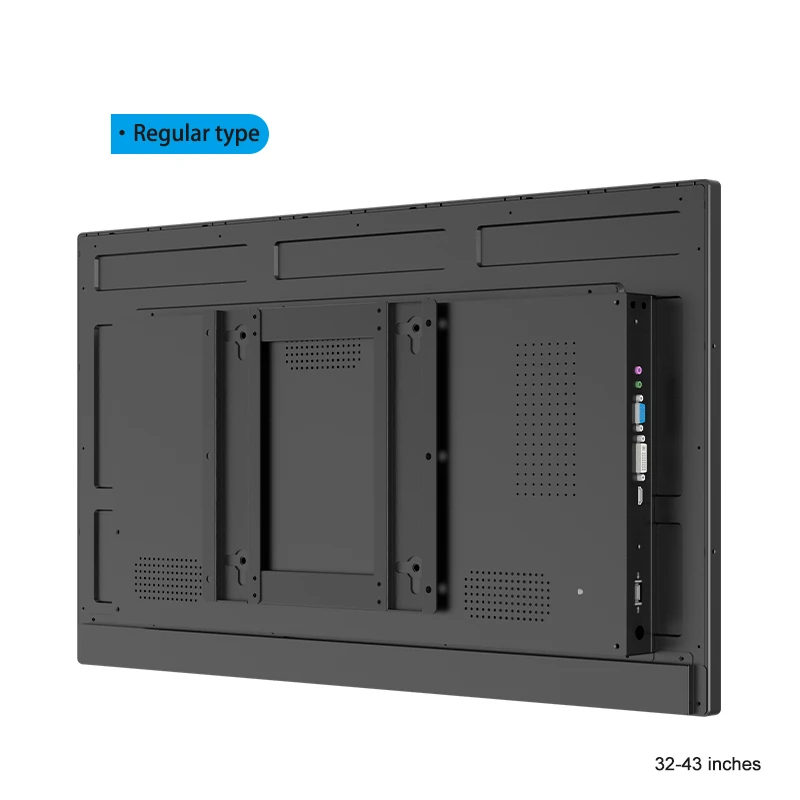
Mechanical integration is a primary technical priority for OEM hardware programs. Chinese display manufacturers must provide comprehensive mechanical adaptation options to suit diverse machine enclosures. Open-frame monitors with precision side-mounting flanges enable flush embedded installation behind custom kiosk cabinetry. Panel-mount architectures incorporate heavy-duty rear clamping brackets and closed-cell silicone gaskets that compress against sheet metal cutouts to achieve front IP65 dust and water sealing.
Standardized rear VESA MIS-D (75x75 mm and 100x100 mm) patterns with M4 threaded inserts provide direct compatibility with articulating swing arms, internal chassis pedestals, and sub-rack assemblies. Precision mechanical modeling using 3D STEP files ensures that wiring harnesses mate cleanly without spatial interference. Finite element analysis (FEA) models simulate mechanical stress distribution under external shock and vibration.
Evaluating structural deflection and thermal convection paths prior to physical tooling prevents localized bezel bending from transferring mechanical stress into sensitive display edges. Industrial monitors feature powder-coated aluminum chassis that resist scratching and surface oxidation. Specialized corrosion-resistant chromate conversion coatings applied prior to powder painting protect internal metal brackets from galvanic corrosion in humid marine or coastal facilities.
Navigate International Statutory and Safety Certifications
Commercializing interactive hardware across European, North American, and Asian markets requires rigorous regulatory compliance. Established Chinese manufacturers maintain comprehensive certification portfolios, including CE marking for European electromagnetic compatibility (EN 55032 Class B and EN 55035), FCC Part 15 Class B verification for North America, and RoHS and REACH environmental compliance. For global distribution, international CB Scheme test certificates under IEC 62368-1 provide mutual recognition across more than 50 participating countries.
Comprehensive test documentation packages include accredited laboratory EMC test reports, safety certificates, and material declarations of conformity. Verifying these documents prior to commercial deployment protects OEMs from regulatory impoundment, customs delays, and legal liabilities.
Establish Strict Quality Control and Traceability Systems
Maintaining uniform quality across multiple production batches requires comprehensive quality management frameworks. Certified manufacturing facilities operate under ISO 9001 quality management systems and ISO 14001 environmental management frameworks. Rigorous quality control procedures span incoming quality control (IQC), in-process quality control (IPQC), and outgoing quality assurance (OQA).
Incoming inspection evaluates raw glass substrates, controller ICs, and LCD panels before they enter cleanroom production lines. Automated optical inspection verifies touch sensor electrode patterns, while automated drop-ball impact testers validate cover glass mechanical strength against IK08 standards.
Manage Production Continuity and Supply Lifecycle
Industrial automation machinery and medical equipment operate over extended multi-year lifecycles. OEMs require hardware platforms that remain dimensionally and electronically stable throughout multi-year production runs. Established Chinese manufacturers maintain disciplined component roadmaps and formal product change notification (PCN) policies.
Strict engineering change order (ECO) protocols ensure that critical sub-assemblies (such as LCD panel revisions, touch controller silicon, and scalar board firmware) are not altered without prior written customer consent. When component obsolescence occurs, manufacturers provide at least six months of advance notice and support last-time-buy (LTB) inventory buffering, protecting OEMs from unexpected redesign costs.
FAQ about Sourcing Touch Monitors from China
Procurement executives and system architects frequently examine these core sourcing questions when evaluating Chinese touch display manufacturers.
How Do Leading Chinese Manufacturers Prevent Optical Delamination?
Automated optical bonding within Class 1000 cleanrooms utilizes optical clear resin (OCR) or optical clear adhesive (OCA) cured under precise ultraviolet radiation and autoclave pressure, eliminating air gaps and preventing moisture delamination.
What Minimum Order Quantities (MOQs) Are Standard for OEM Customization?
Established Chinese manufacturers offer flexible MOQ structures, supporting low-volume prototype batches (5 to 10 units) for pilot testing before scaling to production runs of hundreds or thousands of units.
How Are International Shipping Logistics and Packaging Managed?
Industrial monitors are packaged in reinforced corrugated cartons with custom-molded high-density polyethylene foam corner protectors. Packaging satisfies ISTA 1A transit drop standards, ensuring damage-free international ocean and air freight delivery.
Partner with GreenTouch for Global Touch Monitor Manufacturing
Successful cross-border sourcing requires partnering with a manufacturer that combines advanced cleanroom production, extensive OEM customization, and disciplined quality control. GreenTouch operates modern manufacturing facilities in Shenzhen, delivering certified touch monitors, open-frame displays, and customized touch screens for industrial automation, medical equipment, and self-service kiosks worldwide. Sourcing professionals and project engineers can submit technical drawings and integration requirements directly at https://www.greentouch.com.cn/ for engineering review and rapid prototype sampling.
Media Contact
ShenZhen GreenTouch Technology Co.,Ltd.
Source :ShenZhen GreenTouch Technology Co.,Ltd.
This article was originally published by IssueWire. Read the original article here.
YOUR NEWS, OUR NETWORK.
Do you have Great News you want to tell the world?
Be it updates about your business or your community, you can make sure that it’s heard by submitting your story to our network reaching hundreds of news sites across 6 verticals.